
Every industrial coating is expected to do one thing: protect valuable assets for as long as possible.
Yet coating failures often have little to do with product quality. Because a paint that performs exceptionally well in a water treatment plant usually fails quickly inside a heavily trafficked factory floor.
Every coating is tailored to survive industrial environments. That’s why chlorinated rubber paint is a trusted solution for moisture, weathering, and mild chemicals.
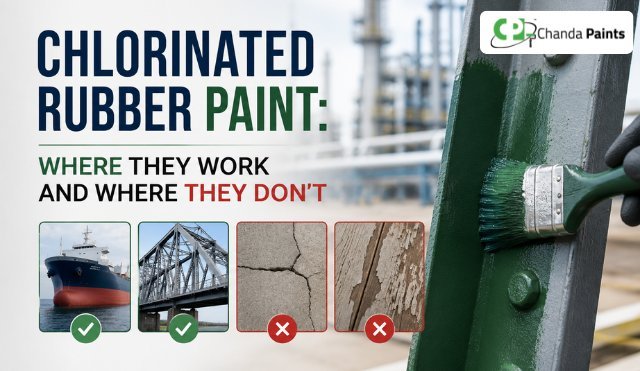
In this guide, we will explore where chlorinated rubber paint delivers outstanding performance and where it falls short. Choose the right protective system before investing in your next coating project.
What Is Chlorinated Rubber Paint?
Chlorinated rubber paint is an anti-corrosive paint formed by chlorinating either natural or synthetic rubber to form a film with good moisture, chemical, and weather resistance properties.
In contrast with decorative paints, this acts as a protection for dip fittings, concrete, steel, and other masonry materials against moisture, salts, mild chemicals, and atmospheric corrosion.
There are many reasons why it is still widely used in various industries, but one of them is its practical use. It dries quickly and forms a film that can be easily repainted.
Where Chlorinated Rubber Paint Works Best
Chlorinated rubber paint dries rapidly, allowing facilities to return to operation sooner than many traditional systems. Understanding where chlorinated rubber paint is used helps determine whether it is the right investment for your project.
Water Treatment Plants
Water treatment plants subject construction elements to constant wetness, chlorine, and a changing environment.
The chlorinated rubber coating serves as a highly effective moisture barrier for tanks, channels, and the structures that support them.
Swimming Pools
Chlorinated rubber paint is widely used in protecting swimming pools from corrosion.
Its superior resistance to chlorinated water and algae development has rendered it an ideal choice for coating concrete swimming pools, competition pools, and recreation pools for several decades now.
Marine and Coastal Structures
Air with high salt content increases corrosion significantly.
Chlorinated rubber paint is an excellent choice for piers, docks, metal railings, harbors, and other coastal structures due to its ability to withstand water and salt spray.
Industrial Pipelines and Storage Tanks
Surfaces of external pipelines and storage tanks transporting water and mild chemicals need economical corrosion protection.
Chlorinated rubber coatings offer corrosion protection to such assets from atmospheric corrosion. Chlorinated rubber is easily maintained during shutdowns.
Factory Walls and Structural Steel
Most manufacturing industries make use of chlorinated rubber paints for structural steel, equipment rooms, storage facilities, and concrete surfaces as a result of their strength and reduced maintenance needs.
Chlorinated rubber paint proves itself reliable for industrial settings with average chemical exposure levels.
Where Chlorinated Rubber Paint Doesn't Perform Well
Every coating is made to survive specific conditions. So every coating has limitations. Ignoring them can lead to expensive repairs. Check out where chlorinated rubber paint does not perform well:
High Heat Environments
Boilers, furnaces, chimneys, and processes involving very high temperatures produce conditions that surpass the tolerance limit of the coating.
The chlorinated rubber paint may become soft, discolored, or lose its adherence under high temperature conditions.
Heavy Chemical Processing Plants
Coatings having a high degree of chemical resistance are necessary for equipment containing strong acids, aggressive solvents, or strong alkalis.
In these cases, epoxy or chemical-resistant coatings give much more protection.
Heavy Mechanical Wear Areas
Traffic from forklifts, continuous wear, and movements of heavy machinery could eventually damage the coating of chlorinated rubber.
Continuous impact on industrial floors makes epoxy floor coating more appropriate.
UV-Intensive Long-Term Exposure
Whereas chlorinated rubber can withstand harsh weather conditions, constant exposure to intense sun rays for several years will eventually lead to chalking and fading.
In architectural coating applications where appearance is an important factor, polyurethane primers provide good color retention.
Chlorinated Rubber vs Epoxy Paint: Which Is Better?
When comparing chlorinated rubber vs epoxy paint, the answer depends on the application and which environment it is going to withstand.
|
Feature |
Chlorinated Rubber Paint |
Epoxy Paint |
|
Drying Time |
Fast |
Moderate |
|
Chemical Resistance |
Moderate |
Excellent |
|
Abrasion Resistance |
Moderate |
Excellent |
|
Moisture Resistance |
Very Good |
Excellent |
|
Ease of Recoating |
Easy |
Moderate |
|
High Heat Performance |
Limited |
Better |
|
Maintenance |
Easier |
Longer service life |
If your project prioritizes quick maintenance, moisture resistance, and economical protection, chlorinated rubber is often the practical choice. On the other hand, epoxy is generally great for aggressive chemicals or continuous industrial abuse.
Are Chlorinated Rubber Costings Worth It?
In short, YES. But only when used in the right environment.
But comparing coatings based only on their upfront price is the biggest mistake people make. A better way to evaluate any industrial coating is by looking at its lifecycle cost.
If a coating lasts longer, requires fewer repairs, and minimizes production downtime, it is considered to be a more economical choice. For water treatment plants, swimming pools, coastal structures, and industrial storage tanks, chlorinated rubber paint offers an excellent balance.
That said, it is one of the most cost-effective options for every application.
Final Thoughts
The reason why chlorinated rubber paint retains its relevance in industrial maintenance is that it does what it should do effectively. This includes areas where water is a major problem, such as coastal buildings, storage tanks, and many other industrial sites.
A better option is to engineer the coating tailored to your operating environment. Talk to Chanda Paints and evaluate your site conditions. Get the most cost-effective solution for your facility.
Frequently Asked Questions (FAQs)
What is chlorinated rubber paint?
Chlorinated rubber paint is an industrial coating formed from chlorinated rubber resin. It provides outstanding protection against moisture, weather, and weak chemical effects, hence its suitability in preventing corrosion in harsh conditions.
Where is chlorinated rubber paint used?
Application Areas for Chlorinated Rubber Paint
Chlorinated rubber paints are frequently employed for surfaces like those of swimming pools, water treatment facilities, seawater applications, storage tanks, pipelines, industrial walls, and bridges.
What surfaces can chlorinated rubber paint be applied on?
You can apply chlorinated rubber paint to properly prepared steel, concrete, masonry, and previously coated surfaces. However, it also depends on their condition and the recommended primer system.
Is chlorinated rubber paint good for industrial use?
Yes. Chlorinated rubber paint is commonly used in industries since it dries up fast, is resistant to moisture, does not corrode in the atmosphere, and is easy to maintain.
Is chlorinated rubber paint suitable for steel structures?
Indeed. It is a good coating for structural steel, pipelines, storage tanks, and other industrial machinery that will help to protect the surface of the metal from rust and other environmental hazards.
Can chlorinated rubber paint be used in chemical plants?
It is suitable in environments where water or weak chemicals are present. However, when dealing with heavy acids, alkalis, or solvents, it is advisable to apply either epoxy coating or any other coating that will resist chemicals.
Is chlorinated rubber paint suitable for marine environments?
Yes. Chlorinated rubber paint does very well for maritime and coastal applications as it gives excellent protection against salt spray, humidity, and weathering to prevent any corrosion to exposed structures.
What are the disadvantages of chlorinated rubber paint?
Limitations of the material include lower wear resistance compared to epoxies, poorer performance at higher temperatures, and less resistance to harsh chemicals and solvents. The material may also chalk under ultraviolet radiation exposure.
How is chlorinated rubber paint different from epoxy paint?
Chlorinated rubber paints are fast drying, easy to maintain, and moisture resistant, whereas epoxy paints have excellent chemical and abrasion resistance properties and durability in tough industrial environments.
When should you avoid using chlorinated rubber paint?
Chlorinated rubber paint should not be used where high temperatures, severe chemical processes, and continuous abrasion are present, since in these cases an epoxy coating would normally offer greater protection