
Factory floors, walls, and areas that face constant splashes often start peeling if coated with ordinary paints. And the repair becomes another maintenance headache.
That’s why waterproof epoxy paint is often considered for moisture-exposed industrial surfaces. It offers strong water resistance, durability and a dense protective finish. But epoxy is not automatically the right waterproofing solution for every wet area.
It depends on how much water the surface encounters, whether exposure is continuous, what lies beneath the coating and how the surface is prepared.
This guide sheds light on where waterproof epoxy paint works best and where it fails to protect. So, keep on reading till the end!
Is Epoxy Paint Waterproof?
Epoxy coatings offer excellent resistance to water and moisture when the right formulation is applied correctly to a properly prepared surface.
But epoxy paint is not automatically a waterproofing system.
There is a major difference between a coating that resists water exposure and a complete system designed to prevent water ingress under continuous or severe exposure.
For industrial applications, factors such as substrate condition, surface preparation, coating thickness, curing, chemical exposure and the type of water contact all matter.
Where Does Waterproof Epoxy Paint Work Well?
Waterproof Epoxy Paint for Floors
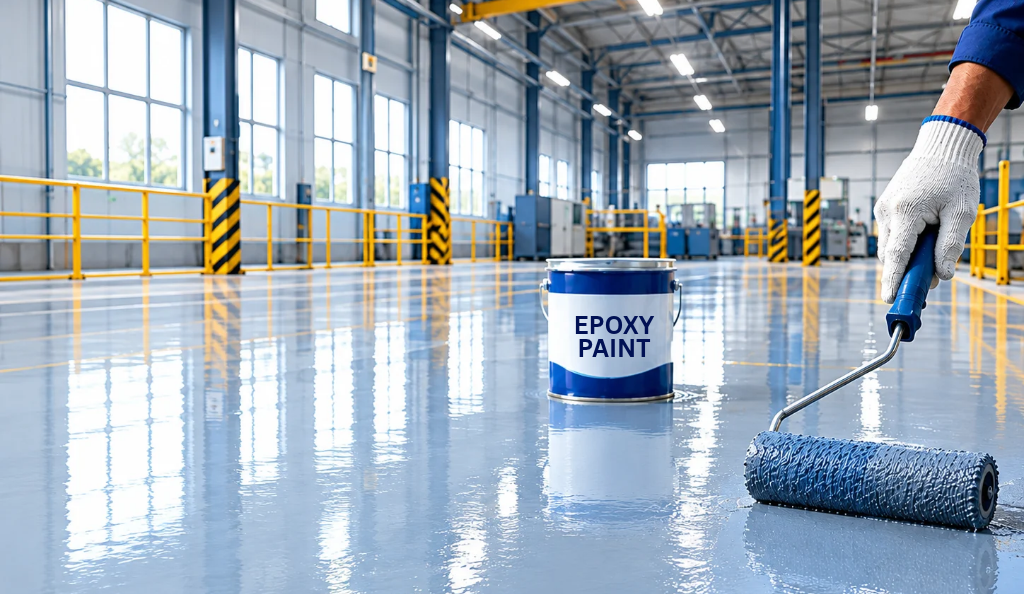
Epoxy coatings are highly practical for use on industrial floors.
Manufacturing plants, storage facilities, workshops and processing areas may encounter cleaning procedures, spills, humidity, and even water pooling at times. A suitable epoxy floor coating can form a hard surface to resist moisture and industrial damage.
But the type of coating system you apply must depend on the specific environment of the area and not just on an epoxy coating that is labeled waterproof. Like an epoxy for wood behave very differently under an epoxy system.
Waterproof Epoxy Paint for Wet Industrial Areas
Areas exposed to frequent washing or moisture get the most benefit from an appropriately engineered epoxy system.
While certain factory spaces, utility zones, equipment zones and certain processing environments require more than just regular decorative paints, factors like adhesion, chemical resistance, abrasion resistance and even moisture resistance become equally important with respect to water resistance.
A paint that works well with splashing water may not be the one suitable for continuously exposed surfaces to water.
Waterproof Epoxy Paint for Walls
You can also apply epoxy coating selectively to certain walls that require moisture resistance, cleanability, and durability.
This would be especially useful in industrial settings where walls will be washed or splashed at regular intervals. However, wall application will need to take into consideration the condition of the substrate and the presence of moisture under the coating.
If there is moisture trapped inside the wall, applying epoxy on top of it will only conceal the problem.
Epoxy Paint for Bathroom and Kitchen
Bathrooms and kitchens have different requirements depending on whether the concern is occasional splashing, constant humidity, cleaning chemicals, standing water or actual waterproofing behind the surface.
So, epoxy paint for bathroom and kitchen should not automatically be considered a substitute for a proper waterproofing system. The substrate and water exposure should determine the solution.
Where Epoxy Paint May Not Be the Right Solution
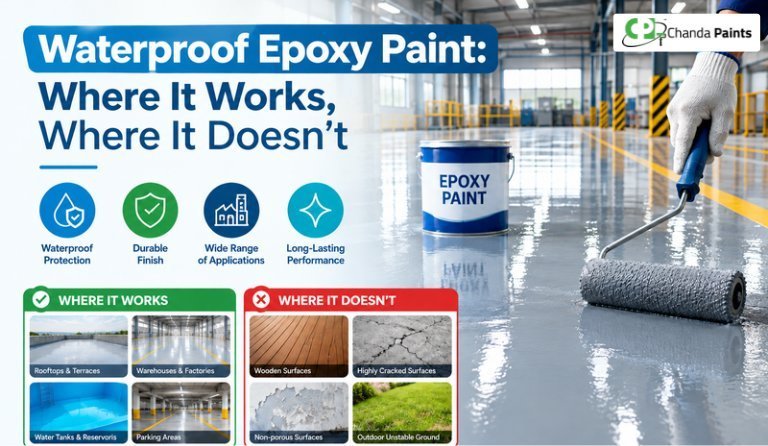
Use of epoxy paint should be avoided in areas exposed to moisture, sun rays, and hot tire traffic. Here are the areas where epoxy paint may not be the right solution:
✘ Surfaces With Active Dampness
If water is continuously moving through a substrate from behind, epoxy should not be treated as a magic barrier.
✘ Areas With Severe Water Immersion
Not every epoxy coating is designed for permanent immersion. Specific conditions require a formulation designed and tested for that environment.
✘ Cracked or Poorly Prepared Surfaces
Even a high-gloss epoxy coating cannot compensate for poor substrate preparation. Professional industrial coating projects always start with surface assessment.
Waterproof Epoxy Paint vs Normal Paint for Water Protection
|
Factor |
Normal Paint |
Waterproof Epoxy Paint |
|
Water resistance |
Generally limited |
Generally high, depending on formulation |
|
Abrasion resistance |
Usually moderate |
Typically much higher |
|
Chemical exposure |
Product dependent |
Available in specialised formulations |
|
Cleaning frequency |
Suitable for lighter conditions |
Better suited to demanding environments |
|
Long-term performance |
Highly application dependent |
Highly dependent on system and preparation |
How to Choose the Best Waterproof Epoxy Paint for Wet Areas
Start by defining the environment rather than starting with the product catalogue. Ask questions:
- Is the surface exposed to occasional splashes or continuous moisture?
- Will forklifts or heavy machinery operate over it?
- Are cleaning chemicals involved?
- Is there standing water?
- Is the substrate concrete, metal or another material?
Once these conditions are clear, the coating specification becomes much easier to determine.
Need the Right Waterproof Epoxy Paint for Your Application?
Water resistance is only one part of coating performance. At Chanda Paints, the focus is on industrial coating solutions selected around the actual demands of the surface and operating environment.
If you are planning to waterproof your facility, talk to the experts at Chanda Paints about the right coating system for your project.
Frequently Asked Questions (FAQs)
Is waterproof epoxy paint truly waterproof or just water-resistant?
The epoxy coating has high water and moisture resistance properties, but that does not mean all epoxy coatings are resistant to water contact. It depends on the type of epoxy coating and the formulation used.
Where can waterproof epoxy paint be used in homes and industries?
It may be applied to appropriate floors and walls in factories, warehouses, workshops, utility rooms, kitchens, bathrooms and other moisture-prone areas. Industrial use will require an appropriate coating system that is compatible with the environment.
Can waterproof epoxy paint be used on bathroom walls and showers?
Yes, the proper epoxy system is capable of providing a robust, washable, and moisture-resistant surface. However, it is not necessarily meant to replace waterproofing behind the wall or under the shower area.
Is epoxy paint better than normal paint for wet areas?
For demanding wet or industrial environments, epoxy generally offers greater resistance to moisture, abrasion and chemicals than conventional decorative paint. The right choice still depends on the specific exposure and substrate.
How long does waterproof epoxy paint last on floors and walls?
There are no standard lifetimes. The service lifetime depends on the traffic, moisture, chemicals, UV rays, surface preparation, coating thickness, and maintenance. Properly selected coatings may ensure lasting protection.
Can waterproof epoxy paint stop seepage and dampness?
It can help control moisture in certain applications, but it cannot be relied upon to stop active water flow or resolve the source of structural seepage. Moisture problems should be diagnosed and treated before coating where necessary.
What surfaces are suitable for waterproof epoxy paint?
Common suitable substrates include properly prepared concrete and masonry, and some epoxy systems are designed for other substrates. The surface must be sound and appropriately prepared for the selected coating system.
Does waterproof epoxy paint work on old, damp, or leaking walls?
It can work on some damp substrates when the product is specifically designed for moisture-tolerant application. However, actively leaking surfaces or surfaces with unresolved water ingress should not simply be coated over; the underlying problem needs to be addressed first.
How many coats of epoxy paint are needed for proper waterproofing?
No fixed number applies to every product. Some systems require a primer plus one or more coats, while specialised moisture-barrier systems specify their own layer structure and thickness. Always follow the manufacturer's technical specification rather than relying on coat count alone.
What are the limitations of waterproof epoxy paint in high-moisture areas?
Epoxy can have limitations where there is active water ingress, hydrostatic pressure, excessive substrate moisture, condensation, cracking or continuous immersion without a suitably designed system. Proper substrate assessment and system selection are essential before application.